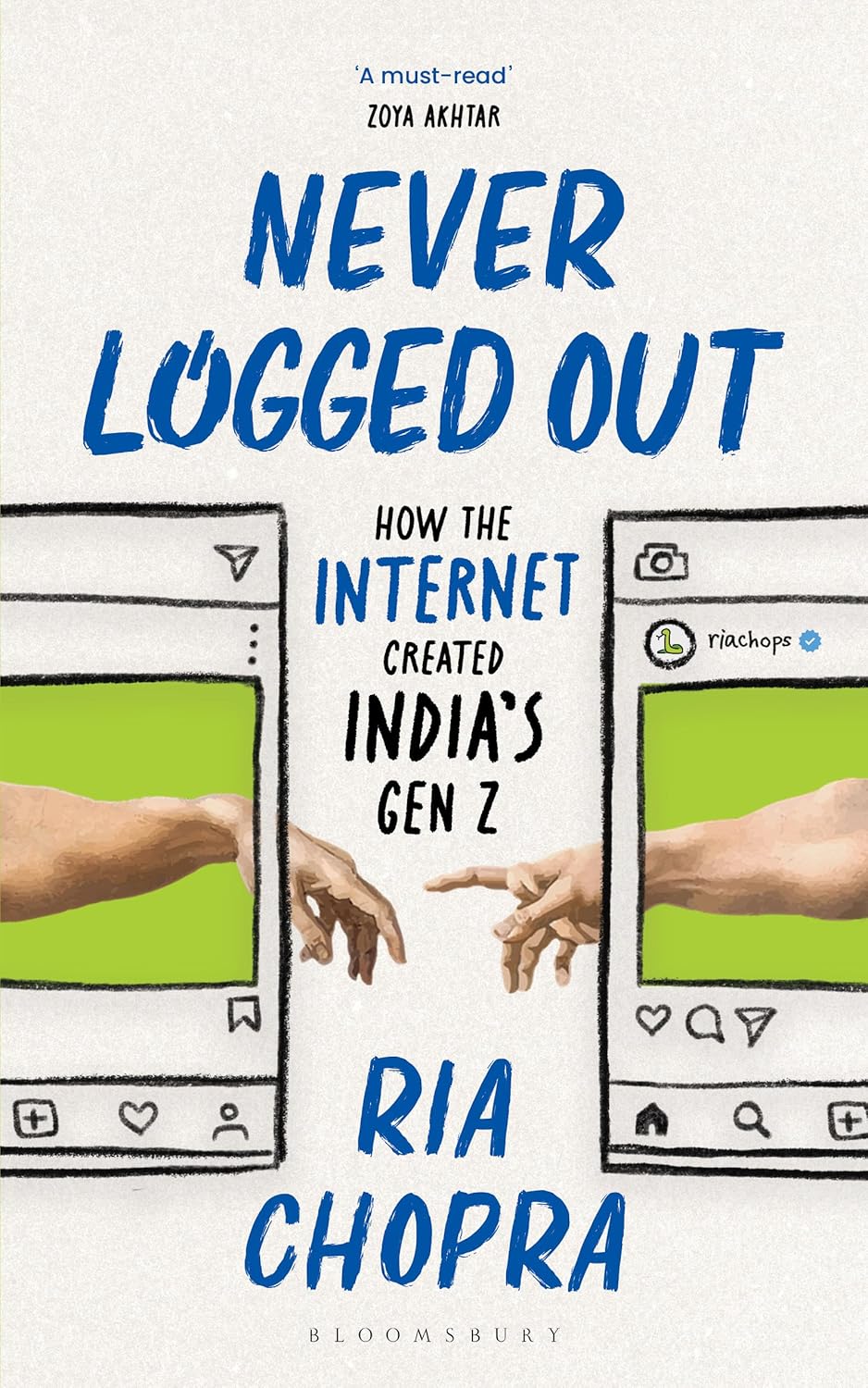
Never Logged Out: How the Internet Created India's Gen Z
Ria Chopra
Highlights
I love people. I am one of those extroverts who will strike up a conversation with a fellow passenger sitting beside me on an aircraft. I firmly believe that coincidence and serendipity are my algorithms of choice.
The problem is this: when we go into an experience being told that this is what is good, this is five stars, then our ability to question whether we actually find it good diminishes. We may think we’re ‘optimising’, but we’re really just leveraging the aggregated opinions of other people to inform our understanding of what ‘good’ art is, instead of forming our own independent opinions.
There is a quote frequently attributed to Carl Jung, though its sources are obscure: ‘The world will ask who you are, and if you do not know, the world will tell you.’
Or do you simply exist in your loving relationships with the feeling of love, not needing visible evidence to constantly prove it?
Sometimes when you re-read old arguments that occurred over text, you might end up feeling just as angry as you were when they first happened. The human ability – the human compulsion – to forget the exact angry words exchanged during interpersonal conflicts is actually essential to resolving those conflicts, because allowing the words, and hence their impact, to fade over time brings us closer to resolution and moving on. Digital archives preclude such possibilities entirely.
All-anonymous apps, in fact, like Reddit, Grapevine, Whisper, and others, actually tend to work quite well – with all users being at an equal level of obscurity and impersonality. On platforms where anonymous accounts coexist with people proclaiming and building their identities, however, facelessness and namelessness can often be weaponised to heckle (at the very least) and outright threaten, bully, and scare anybody who piques interest.
In 1971, psychologist and economist Herbert A. Simon first conceptualised what would later become the ‘attention economy’ as we know it today, describing how a ‘wealth of information’ consequently creates a ‘poverty of attention’, necessitating a need for people to consciously choose what to pay attention to.
In her 2023 piece for BuzzFeed News, Clarissa-Jan Lim applied the term to our digital behaviour: ‘We film ourselves, we film our surroundings, we film the people we know and the people we don’t, and we post freely and carelessly. This is the age of panopticontent – everything is content for the creating, and everyone is a nonplayer character in my world.’
…but I find that nobody really wins when we try to goad people into publicly stating opinions that they may not have the knowledge or expertise to properly form.